

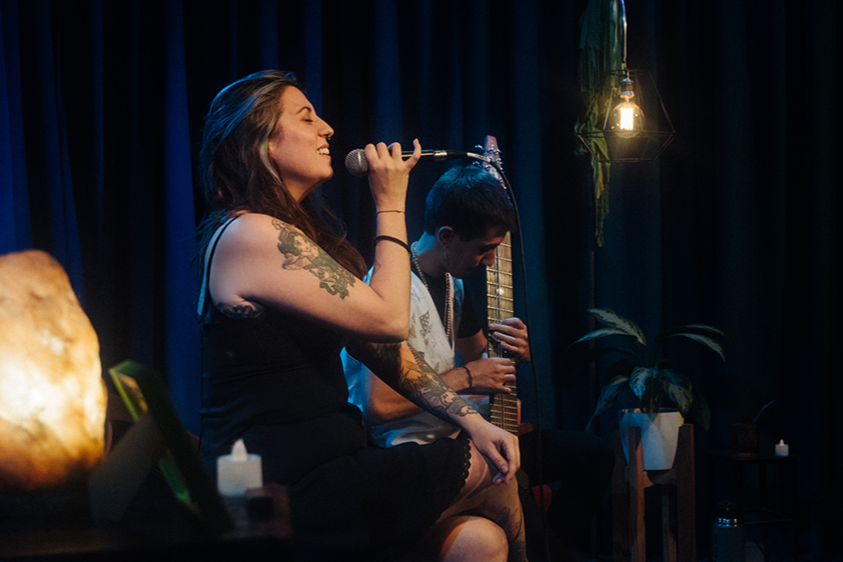
Julieta Natasha
Julieta Natasha Waidelich is a singer born in Buenos Aires in 1988. From an early age, she was drawn to the arts, particularly music, drawing, and painting. Music always held a central place in her home: her father introduced her to a broad and diverse sonic universe that ranged from folklore and tango to rock, cumbia, and English-language international bands.
During her final year of primary school and first year of secondary school, she discovered the potential of her voice, encouraged by Jorge Neme, director of the choir at Instituto Nuestra Señora de Luján in Villa Pueyrredón, who invited her to join the soprano section. This first profound experience of musical practice led her to study guitar with teacher Gabriel De Piero, incorporating the instrument as a tool for accompaniment and self-expression.
In 2012, she began her professional vocal training with Soledad Mársico. At the same time, she studied theatre and stand-up comedy, a discipline she pursued actively for three years, performing at Paseo La Plaza and sharing the stage with prominent figures from Argentine comedy. These experiences broadened her relationship with the stage voice, physical expression, and direct communication with an audience.
In 2015, she worked as a Performing Arts teacher for children at Centro Cultural Campana, combining vocal, theatrical, and play-based tools. Between 2017 and 2019, she formed a guitar-and-voice duo with guitarist Federico Baffico. In 2021, while living in Luján, San Luis, Argentina, she became part of the musical trio “Caminos de Viento,” alongside Nicolás Arri on percussion and Giuliano D’Uva on Chapman Stick. The trio performed at private and municipal events, including the Festival del Artesano in the town of San Francisco del Monte de Oro.
Through her training with Soledad, she has developed a versatile voice that has allowed her to explore a wide range of musical genres, including tango, folklore, pop, boleros, and rock.
Since 2023, she has been based in Valencia, Spain. She is currently in the third year of her teacher-training program in The Free Voice Training and teaches both in person and online, working with teenagers and adults.
For Julieta, the voice is not simply an instrument for singing, but a profound expression of identity. Our own sound reveals who we are and how we position ourselves in the world. She believes that a healthy, conscious voice is a powerful tool for self-empowerment and self-knowledge. In her classes, she creates a space that combines vocal technique and training with attentive, sensitive, and emotionally aware listening, understanding that our inner and emotional processes are directly reflected in the way each person sounds and expresses themselves.